Albanian Language Family: Where Albanian Fits and What It Resembles
Albanian belongs to the Indo-European family but forms a branch of its own, with no close living relatives. Here is where it comes from and what it resembles.
Contents8 sections
- Albanian language family: a branch of its own
- Albanian language origin: what linguists say
- Is Albanian a Slavic language?
- What language Albanian is similar to: words from Latin, Greek, Turkish and Slavic
- The Balkan Sprachbund: grammar shared with the neighbours
- Gheg, Tosk and one standard language
- Familiar ground and strange territory for English speakers
- What feels familiar
- What feels unfamiliar
- Is Albanian hard to learn?
- FAQ
Albanian language family: a branch of its own
Albanian belongs to the Indo-European family, the same family as English, Greek and Hindi. Within that family it forms a separate branch and is the branch's only living language. It has no close relatives of the kind Spanish has in Italian or Portuguese.
Linguists divide the family into branches. The Slavic branch includes Russian, Polish, Serbian, Czech and about a dozen more. The Romance branch has Italian, French and Romanian, and the Germanic branch has German and English. Languages in the same branch share words and grammar, and their speakers can often partly understand each other: a Pole in Prague can read half the shop signs. Look at any Albanian language family tree and you will find no such neighbour, just one language and its dialects. Greek and Armenian are in the same position, each forming a branch of its own.
| Branch | Example languages | How close to Albanian |
|---|---|---|
| Slavic | Russian, Bulgarian, Serbian | Only the shared Indo-European heritage, plus loanwords from living side by side |
| Romance | Italian, Romanian, French | No direct kinship, but Latin gave Albanian its largest layer of borrowed words |
| Germanic | English, German | Distant kinship at the level of the whole family |
| Greek | Greek | A separate branch, like Albanian; much shared grammar from centuries as neighbours |
| Armenian | Armenian | A separate one-language branch, not directly linked to Albanian |
| Albanian | Albanian | One language, two dialects: Gheg and Tosk |
Albanians call their language shqip "Albanian" and their country Shqipëri "Albania". The English name "Albanian" goes back to an ancient local tribe, the Albanoi. The most common estimate puts the number of speakers at around 7.5 million, spread across Albania, Kosovo, North Macedonia and Montenegro, with a diaspora in Italy, Greece, Switzerland and the USA. Reference works vary considerably on this, so treat the figure as a rough guide.
The written history of the language is short. The earliest surviving record is a baptismal formula from 1462: a few words of the rite noted down by Pal Engjëlli, Archbishop of Durrës. The first printed book, the Meshari "missal" by the priest Gjon Buzuku, appeared in 1555. By then Albania's Slavic neighbours had been writing for more than five centuries.
Albanian language origin: what linguists say
Albanian is thought to descend from one of the ancient languages of the Balkans, known as the Palaeo-Balkan languages. Almost nothing written in them survives, so the family history has to be pieced together from indirect evidence.
There are two main candidates. Illyrian was spoken in the west of the peninsula, roughly where Albanians live today. Thracian, or the closely related Daco-Moesian, was spoken further east, and the ancient words that Albanian shares with Romanian count in its favour.
Is Albanian a Slavic language?
No. Albanian shares a common ancestor with the Slavic languages only at the level of the whole Indo-European family, and no closer. The impression of kinship comes from geography: for centuries Albanians lived alongside Serbs, Macedonians and Bulgarians and borrowed hundreds of words and some grammar from them.
The confusion is understandable. On the map Albania is surrounded by Slavic-speaking countries, some village names in the north sound distinctly Slavic, and everyday speech includes words like bisedë "conversation" and gozhdë "nail", both borrowed from Slavic. Add a definite article on the end of the word, which Bulgarian also has, and the kinship seems obvious.
In linguistics, though, kinship is measured by core vocabulary and grammar: numbers, pronouns, body parts, family terms, words like water and fire, word endings. This layer is almost never borrowed, and here Albanian is a long way from Slavic. A language can absorb a thousand words without being related at all. English is full of French and Latin vocabulary, and nobody calls it a Romance language.
There is a simpler test. Listen to the radio in a Tirana taxi. A Polish or Czech speaker who can follow the gist of Serbian or Bulgarian without any preparation will catch nothing beyond "internet" and "football".
What language Albanian is similar to: words from Latin, Greek, Turkish and Slavic
Albanian vocabulary is like a layer cake: a small native core beneath thick layers of borrowings, mostly from Latin, then Greek, Turkish, the Slavic languages and Italian. That is why Albanian keeps seeming "a bit like" several different languages.
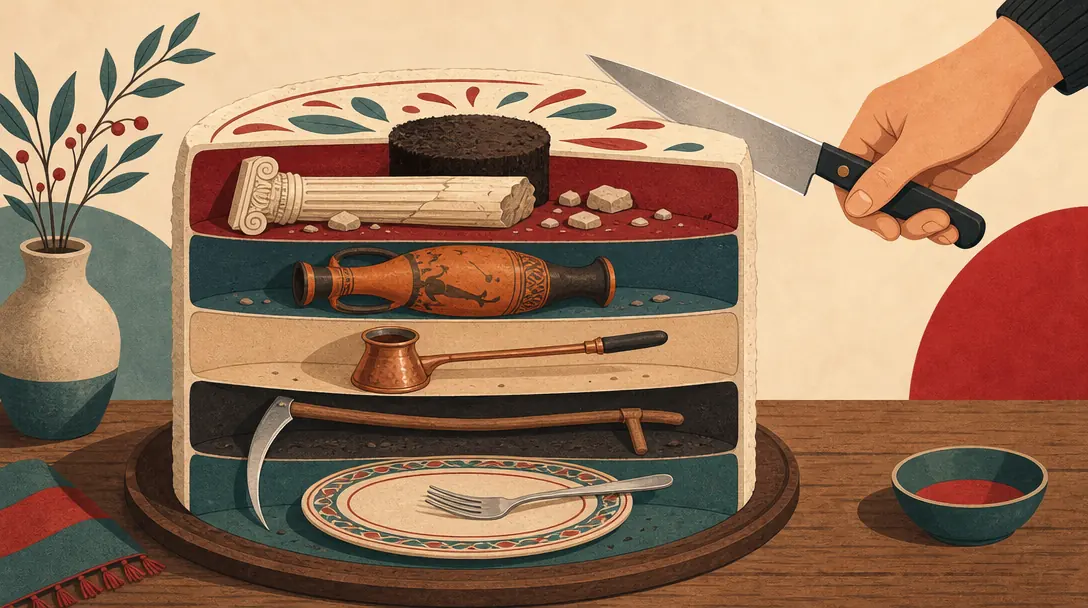
An early count by the Austrian linguist Gustav Meyer gives a sense of scale. Of the 5,140 words he analysed, he classed about 400 as native, 1,420 as Romance, 1,180 as Turkish, 840 as Greek and 540 as Slavic. Later counts refined the numbers, but the overall proportions broadly hold.
Latin is the largest borrowed layer. The Romans ruled the Balkans for several centuries and left words even for basic ideas: mik "friend", qytet "city", mbret "king", kalë "horse". These words changed a great deal along the way; without a dictionary you would never spot imperator in mbret.
Greek words arrived in two waves, one ancient and one from Byzantine to modern times, covering church vocabulary, plants and crafts. Turkish supplied the vocabulary of everyday life during five centuries of Ottoman rule. Dyqan "shop" is on signs in every town, and in a café you might order qebap "kebab" and slip the change into your xhep "pocket". So is Albanian similar to Turkish? Only where the words of the market and the kitchen overlap. The grammar comes from different worlds. Turkish is agglutinative, with vowel harmony and no grammatical gender, while Albanian is an inflecting Indo-European language with gender and cases.
Slavic loans cluster around farming and nature, such as kosë "scythe". Italian contributed food and household words like pjatë "plate", and recent decades have brought the international vocabulary shared across Europe.
| Source | Albanian word | Meaning | Original word |
|---|---|---|---|
| Latin | mik | friend | amicus |
| Latin | qytet | city | civitas |
| Latin | mbret | king | imperator |
| Greek | trëndafil | rose | triantafyllo |
| Turkish | dyqan | shop | dükkân |
| Turkish | xhep | cep | |
| Slavic | bisedë | conversation | beseda |
| Slavic | gozhdë | nail | gvozd |
| Italian | pjatë | plate | piatto |
This is why a Serb, an Italian and a Turk can each find something familiar in Albanian. Loanwords, however, do not prove kinship.
The Balkan Sprachbund: grammar shared with the neighbours
Albanian, Greek, Romanian, Bulgarian and Macedonian lived side by side for centuries and developed shared grammatical features, even though they belong to four different branches. Linguists call this the Balkan Sprachbund, or language union, and structurally its members are Albanian's closest neighbours.
Related languages resemble each other because they share an ancestor. In a language union the similarity has a different source: for generations people spoke two languages at once, and grammar gradually adjusted to the neighbours. The common ground is considerable:
A definite article on the end of the word. Mal is "a mountain", mali is "the mountain". Bulgarian grad — gradăt "town — the town" and Romanian lup — lupul "wolf — the wolf" work the same way.
A future tense built on "want". The particle do (do të shkoj "I will go") grew out of the verb dua "to want", and Greek tha and Bulgarian shte do the same job.
Loss of the infinitive. Standard Albanian has no form like "to do": instead of "I want to do" you say dua të bëj, literally "I want that I do". Greek and Bulgarian work the same way.
Counting 11–19 as "one-on-ten": njëmbëdhjetë "eleven" = një + mbë + dhjetë.
Gheg, Tosk and one standard language
Albanian has two major dialects: Gheg in the north, including Kosovo, and Tosk in the south, with the conventional dividing line along the Shkumbin river in the centre of the country. The standard language used in writing, schools and the news is based mainly on Tosk.
You can hear the differences straight away. Tosk went through rhotacism: n between vowels became r. Hence Gheg vena and Tosk vera "wine", or Shqipni and Shqipëri "Albania". Gheg kept its nasal vowels (nândë "nine" instead of nëntë) and an infinitive with the particle me: me punue "to work", where the standard says për të punuar.
Speakers of the two dialects generally understand each other without much trouble, especially in an unhurried conversation. The rapid speech of an elderly villager from the mountains near Shkodër will be hard going for a southerner from Gjirokastër, but the gap is roughly that between a Bavarian and a northern German. It is nowhere near two separate languages.
The standard was settled in two stages. The 36-letter Latin alphabet was adopted at the Congress of Manastir (today's Bitola) in 1908. Unified spelling rules were approved by the Orthographic Congress in Tirana in 1972, and today Albania and Kosovo share the same standard, even though Gheg is what you hear on the streets of Pristina. The Arbëresh of southern Italy and the Arvanites of Greece have a story of their own: their ancestors settled there in the Middle Ages, and their speech preserves an older stage of Tosk.
Familiar ground and strange territory for English speakers
English speakers start with a few advantages: the Latin alphabet, the th sounds, plenty of Latin roots with English cousins and a handful of ancient shared words. What feels new is everything English lost long ago: cases, gender on every noun, articles attached to the end of words, short pronouns and the admirative mood.
What feels familiar
The alphabet is Latin, and the spelling is far more regular than English. Two sounds that trip up learners from many countries, dh and th, are simply the sounds in English the and think. The Latin layer helps too: qytet "city" and English city both go back to civitas, mik "friend" sits alongside amicable, and mbret "king" shares its origin with emperor.
There are also a few ancient relatives of English words: natë "night", emër "name", tre "three", ti "you" (compare archaic English thou). Nobody borrowed these from anyone; they are shared Indo-European heritage. There are not many, but spotting them is a small pleasure. Even the Albanian future has an English parallel: will once meant "want", just as do comes from dua.
What feels unfamiliar
Cases come first. A word changes its ending depending on its role in the sentence, something English keeps only in pronouns like he — him — his. Standard grammar counts five cases: nominative, genitive, dative, accusative and ablative; some descriptions add a vocative. The genitive and dative share the same form, which means slightly less to memorise. Every noun also has a gender, masculine or feminine, with traces of a neuter.
The article attaches to the end of the word and changes form: mal "mountain" — mali "the mountain", vajzë "girl" — vajza "the girl". You have to keep track of definiteness on every noun, and the case endings depend on it. The linking articles i, e, të come before adjectives and in the genitive: shtëpia e madhe "the big house", libri i Anës "Ana's book". Conversation is also full of short pronouns like e, më, të, which merge into ma, ta, ia. At first they sound like noise between the words.
The most exotic feature is the admirative, a mood for surprise, unexpected discovery or irony. Say you were sure the café was closed, and it turns out to be packed: an Albanian can express that with a single verb form. It is built in a way that sounds unusual to European ears, by adding endings from the verb "to have" to the participle. All of these topics are covered, with tables, in the grammar guide, which is worth keeping to hand once you reach your first texts.
| Feature | In Albanian | In English |
|---|---|---|
| Cases | Five (six with the vocative), endings change | Only traces in pronouns: he, him, his |
| Gender | Masculine, feminine, traces of neuter | Only in pronouns: he, she, it |
| Article | On the end of the word: mal — mali | Before the word: the mountain |
| Admirative | A separate mood of surprise | None; expressed with "so…!" or "it turns out" |
| Future tense | Particle do të + verb | will + verb |
| Reading | Almost letter by letter, stable stress, usually on the last syllable of the stem | Irregular spelling, shifting stress |
Is Albanian hard to learn?
Albanian is of above-average difficulty: basic phrases take a few weeks, but confident grammar with articles, cases and moods needs steady, systematic work. The good news is that reading is easy from day one, so you can put what you learn to use almost immediately.
For reference, the US Foreign Service Institute (FSI) places Albanian in the third of its four difficulty categories for English speakers, at around 44 weeks of study. That makes it harder than Spanish or French but noticeably easier than Arabic or Chinese.
What's easy. Reading: each letter or digraph stands for one sound, there are almost no exceptions, and the Latin alphabet is familiar. Stress is stable and usually falls on the last syllable of the stem. Word order is flexible, so you can shift the emphasis by moving words around.
What's hard. Vocabulary comes first. There are very few familiar words, so each one has to be learned from scratch, and flashcards with audio plus regular review help a lot. Then come the case system, articles with adjective forms and irregular verbs such as jam "to be", kam "to have", them "to say" and vij "to come", which change beyond recognition in the past tense (vij "I come" — erdha "I came"). Add the subjunctive in place of the infinitive, and the admirative. Albanian also has far fewer learning materials than the major European languages, so audio and real listening practice matter more than usual.
Some sounds take work too. Ë is a short, neutral vowel close to the one in English about, q is a soft sound somewhere between "ch" and "ky", and gj is its voiced counterpart, between "j" and "gy". On the Albanian alphabet with audio page all 36 letters are recorded by a native speaker: listen to them before you start memorising words.
A realistic order is the alphabet and reading first, then travel phrases, then basic grammar and finally simple texts. For a holiday the first two steps are enough, and ready-made phrases for cafés, taxis and shops work from day one. Foreigners who speak Albanian are rare. Say faleminderit "thank you" to a burek seller in Durrës, and you will most likely hear a surprised "Oh, you speak Albanian?", followed by a couple of tips on where to go.
Frequently asked questions
Is Albanian a language isolate?
No. Albanian belongs to the Indo-European family, alongside English, Greek and Hindi. It is sometimes mistaken for an isolate because it forms its own branch with no other living members. A true isolate, such as Basque, has no proven relatives at all.
How many people speak Albanian?
The most common estimate is around 7.5 million native speakers. They live in Albania, Kosovo and parts of North Macedonia and Montenegro, with a large diaspora in Italy, Greece, Switzerland and the USA. Reference works vary considerably, so the figure is best treated as a rough guide.
What is the Albanian alphabet and when was it adopted?
Albanian is written in the Latin alphabet. The 36-letter alphabet was approved in 1908 at the Congress of Manastir, today's Bitola. It has nine digraphs (dh, gj, ll, nj, rr, sh, th, xh, zh), two letters with diacritics, ç and ë, and no letter w.
How do you say "hi" and "good afternoon" in Albanian?
The neutral greeting for any time of day is Përshëndetje "hello". "Good afternoon" is Mirëdita, while in the morning people say Mirëmëngjes "good morning" and in the evening Mirëmbrëma "good evening". Among friends you will often hear a short Tung "hi" in Kosovo and Ç'kemi "how's it going" in Albania.
What do Albanians call their own language?
In Albanian the language is shqip, the people are shqiptarë "Albanians" and the country is Shqipëri "Albania". The words "Albanian" and "Albania" used in other European languages go back to the name of an ancient local tribe. Inside the country you will only hear shqip.
How long does it take to speak basic Albanian?
With 20–30 minutes a day, you can manage everyday phrases for cafés, shops and taxis with confidence in about four to six weeks. Simple conversations about yourself, your work and your plans take around three to four months. After that, much depends on practice with native speakers: the grammar takes time, but reading can be learned in a couple of evenings.
Is Albanian similar to Greek or Romanian?
By origin they belong to three different branches, Albanian, Greek and Romance, with no direct kinship between them. All three are part of the Balkan Sprachbund, though, so they share a good deal of grammar: a future built on "want", the loss of the infinitive and, in Albanian and Romanian, an article on the end of the word. Albanian vocabulary also contains many Greek and Latin loans, so Greek and Romanian speakers will recognise individual words.