Albanian Songs: Genres, Singers and How to Learn the Language
Albanian music runs from southern iso-polyphony to estrada stage pop and modern rap. Here are ten Albanian songs for a first listen, plus the singers and tips for learning the language.

Contents8 sections
- Albanian songs to start with: 10 tracks for a first listen
- From iso-polyphony to rap: the genres of Albanian music
- Albanian folk music and iso-polyphony
- Estrada and pop
- Albanian rap
- Festivali i Këngës and Eurovision
- Albanian singers worth knowing
- Pop and rap in Albanian
- Global stars with Albanian roots
- Opera singers
- Where to listen, and how to find a song from a few words
- Learning Albanian with songs in five steps
- 10 words you'll hear in almost every Albanian love song
- FAQ
Albanian songs to start with: 10 tracks for a first listen
Albanian music has three broad strands: folk music, including the iso-polyphony of the south; estrada, the orchestral stage pop that grew up around Festivali i Këngës; and modern pop and rap from Albania, Kosovo and the diaspora. Ten tracks drawn from all three make a good first playlist.
The table mixes estrada classics, Eurovision entries, viral hits and rap. The "Albanian song about November" that so many people search for is Nëntori ("November") by Arilena Ara. It came out in 2016, and a dance remix by Bess carried it around the world. Beginners should also try bilingual collaborations such as Zemër. If you remember some school French, half the lyrics give you something to hold on to, and the Albanian lines no longer sound like one unbroken stream.
| Song | Artist | Year | Genre | Title meaning and why it's interesting |
|---|---|---|---|---|
| Moj e bukura Shqipëri | Vaçe Zela | classic | estrada | "Oh, beautiful Albania": a voice every generation in the country knows |
| Këngë labe (recordings by the Pilur ensemble) | Lab Polyphonic Group of Pilur | traditional | iso-polyphony | "Lab song": unaccompanied part-singing and the best introduction to Albanian folk music |
| Suus | Rona Nishliu | 2012 | art pop | Latin for "one's own": fifth place at Eurovision, Albania's best result |
| BonBon | Era Istrefi | 2015 | pop, dancehall | "Sweetie": one of the first Albanian tracks to travel far beyond the Balkans |
| Nëntori | Arilena Ara | 2016 | pop | "November": a break-up song that became an international hit thanks to a remix |
| Zemër | Soolking & Dhurata Dora | 2019 | pop, raï | "Heart": an Albanian–French duet and an easy way in for beginners |
| Me Tana | Elvana Gjata | 2019 | pop | Gheg for "with everything, all of it": a high-energy hit in the northern dialect |
| Lejla | Butrint Imeri | 2022 | pop | slang name for a banknote; a song about love and money, melodic pop with clear diction |
| Toto | Noizy feat. RAF Camora | 2018 | rap | a name, so no translation: textbook Albanian street rap, with lyrics in Albanian, English and German |
| Zjerm | Shkodra Elektronike | 2025 | folk, electronic | Gheg for "fire" (standard zjarr): folk melodies over techno, eighth place at Eurovision |
From iso-polyphony to rap: the genres of Albanian music
Each corner of Albania has its own sound: the south sings unaccompanied iso-polyphony, while the north performs epic songs to the one-stringed lahutë. Towns and cities have had estrada since the 1960s, and today the charts belong to pop and rap from Tirana, Pristina and the diaspora.
Albanian folk music and iso-polyphony
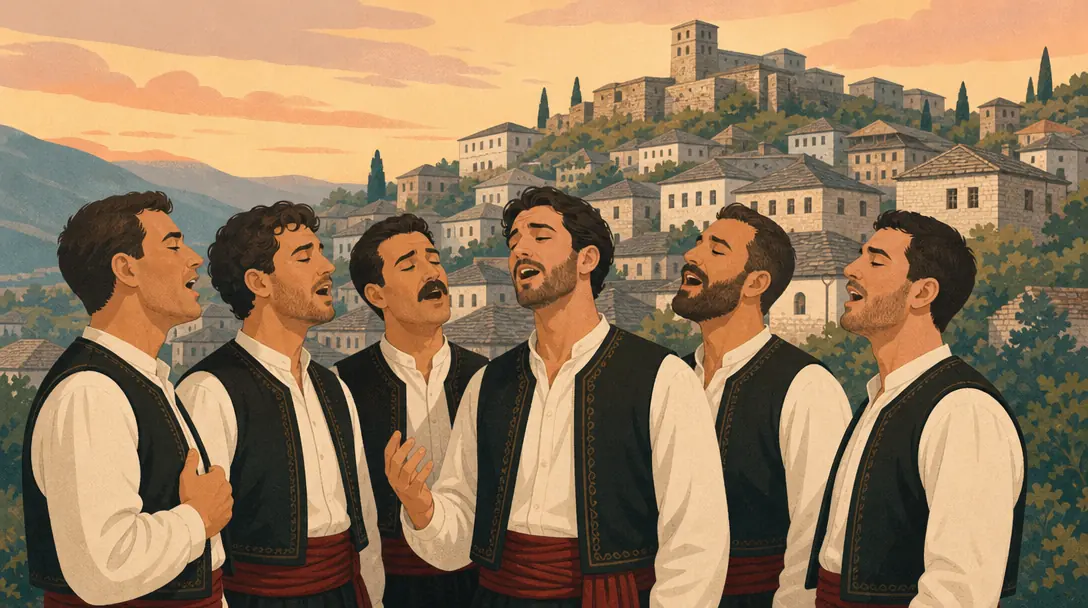
Traditional music is usually divided into Gheg in the north and Tosk and Lab in the south. The south's best-known tradition is iso-polyphony. Several soloists carry the melody while the rest hold a continuous hum, the iso (drone), which supports the other voices like a foundation. It is sung in Labëria, Toskëria, Çamëria and Myzeqe, and Lab songs are considered the most complex, with up to four independent voices. Individual words are easier to catch if you already know some vocabulary from the mountainous south, where the tradition was born. The easiest place to hear polyphony live is the National Folklore Festival in Gjirokastër, held every five years since 1968.
The north is a different world. Singers there perform long epic songs, këngë kreshnike, to the lahutë (a one-stringed instrument) and play the çifteli (a two-stringed instrument: one string holds the drone, the other plays the melody). Alongside singing, the south loves its instrumental saze ensembles of clarinet, violin and the def frame drum. Go to a wedding anywhere near Korça and you are almost certain to hear their slow, lingering kaba pieces. Guests listen first and then get up to dance.
Estrada and pop
Urban estrada took shape around Festivali i Këngës: ballads with a full orchestra and trained, almost operatic vocals. This school produced Vaçe Zela and Avni Mula, and later Ardit Gjebrea, Elsa Lila and Aurela Gaçe. In the 1990s the scene opened up to the outside world, and artists from Kosovo and North Macedonia joined in.
Today's Albanian pop songs come out of two capitals at once, Tirana and Pristina, and Balkan rhythms sit comfortably alongside a Western sound. Folk motifs haven't gone anywhere. Zjerm by the duo Shkodra Elektronike, along with the folk breaks inside many pop hits, shows neatly how tradition makes its way into the charts.
Albanian rap
Albanian-language hip-hop is closely bound up with the diaspora. Large Albanian communities have long lived in Germany, Switzerland and Austria, so rappers from Kosovo and Albania fill venues there and their tracks reach the German-language charts. The key names are Noizy, born in Sukth and raised in London; Ledri Vula from Pristina; and Azet, born in Tirana to a Kosovar family and based in Dresden.
For learners, Albanian rap is hard going: the tempo is fast and half the words are slang or Gheg forms. The reward is hearing how the language is actually spoken on the street. In summer, when the diaspora comes home to Albania and Kosovo, these tracks boom out of cars with German number plates.
Festivali i Këngës and Eurovision
Festivali i Këngës ("Festival of Song") is Albania's main song contest, run by the public broadcaster RTSH since 1962, usually in December. Since 2003 it has also served as the national selection for Eurovision, and the winner normally goes to the contest the following spring.
For decades the festival was the country's main stage, where audiences first heard new songs and new names. The record for wins belongs to Vaçe Zela, who won more than ten times. In 1998 Alberie Hadërgjonaj became the first winner from Kosovo, with Mirësia dhe e vërteta ("Goodness and truth").
The rules require competing songs to be in Albanian. Some artists later rewrite their lyrics in English for Eurovision, but many keep the original. For learners these songs are ideal: the diction is clear and the official lyrics are easy to find.
Albania made its Eurovision debut in 2004 and went straight into the top ten. Its best result so far is Rona Nishliu's fifth place with Suus, where only the title is Latin and the lyrics are in Albanian.
| Year | Artist | Song | Final placing |
|---|---|---|---|
| 2004 | Anjeza Shahini | The Image of You | 7 |
| 2008 | Olta Boka | Zemrën e lamë peng | 17 |
| 2012 | Rona Nishliu | Suus | 5 |
| 2018 | Eugent Bushpepa | Mall | 11 |
| 2025 | Shkodra Elektronike | Zjerm | 8 |
| 2026 | Alis | Nân | 13 |
Albanian singers worth knowing
The Albanian singers people look up belong to two groups: those who sing in Albanian and are famous in Albania, Kosovo and the diaspora, and global stars with Albanian roots who sing mostly in English. The "Albanian singer" from that video you half-remember is almost certainly in one of them.
Pop and rap in Albanian
The classic voice is Vaçe Zela, one of the most recognisable in Albanian estrada. Among today's singers, the most searched-for is Arilena Ara, followed by Elvana Gjata, Dhurata Dora, Era Istrefi and Dafina Zeqiri. Among the men, look out for Butrint Imeri and Dardan. They all work where pop meets Balkan rhythms, and nearly every one of them has recorded with foreign artists.
In rap the reference points are the same three: Noizy, Ledri Vula and Azet. Their tracks make a good listening test once you can follow fast speech.
Global stars with Albanian roots
Dua Lipa was born in London to parents from Kosovo and speaks Albanian. She has no official releases in Albanian, although she sang the Albanian song "Era" live with her father at Sunny Hill in Pristina. Rita Ora was born in Pristina and moved to the UK as a child.
Bebe Rexha and Ava Max grew up in Albanian families in the USA: Bebe Rexha's parents are Albanians from North Macedonia, and Ava Max's are from Albania. You won't learn much Albanian from their songs, but if you're trying to place a world-famous singer of Albanian origin, it is most likely one of these four.
Opera singers
The best-known Albanian opera singer is Inva Mula, a lyric soprano from Tirana. Hers is the voice of Diva Plavalaguna in Luc Besson's The Fifth Element: first an aria from Donizetti's Lucia di Lammermoor, then the electronic vocalise "The Diva Dance". Éric Serra wrote it in a range no live voice can reach, so some of the notes were finished digitally.
Inva Mula's mother, Nina Mula, was also an opera singer, originally from Izhevsk in Russia. The other big name is Ermonela Jaho, one of the world's leading sopranos, who sings at Covent Garden, the Metropolitan Opera, La Scala and the Vienna State Opera.
Where to listen, and how to find a song from a few words
The easiest places to hear Albanian songs are the major streaming services and YouTube. A song you caught on TikTok or in a café is quickest to identify with Shazam or a similar app; if that fails, search for a word you heard, typed in Albanian spelling.
On streaming services, search for playlists called "Albanian hits" or "muzikë shqip"; on YouTube, follow the channels of artists and record labels. RTSH's channel uploads Festivali i Këngës performances. Give the pirate sites promising "new Albanian songs" a miss: broken links and mislabelled tracks are the norm there.
Say a song was playing in a café on the Durrës seafront and Shazam couldn't pick it out over the noise. The trick is to turn what you heard into Albanian spelling. You can type ë and ç as e and c, as search engines accept both. All the reading rules are in our Albanian alphabet guide, and you can check a word from the chorus and hear it in the translator with native-speaker audio.
| What you hear | How it's spelt | Example |
|---|---|---|
| "sh" as in "shoe" | sh | shpirt, "soul" |
| "j" as in "jam" | xh | xhan, "dear" (affectionate) |
| a soft "ch", close to "ty" | q | qiell, "sky" |
| a soft "j", close to "dy" | gj | gjumë, "sleep" |
| "uh" as in "about" | ë | zemër, "heart" |
| a dark "l" as in "full" | ll | mall, "longing" |
| a rolled "r" | rr | ëndërr, "dream" |
Learning Albanian with songs in five steps
Songs are excellent for training your ear and pronunciation, but only if you approach them methodically. Take one song, listen to it several times with a different task each time, and write the words down.
Pick a slow song with clear diction, such as an estrada ballad or a festival entry. Save rap and fast pop for A2–B1.
Listen two or three times without the lyrics and note the words you recognise. At first these will be zemër, të dua and natë, which is already a start.
Find the official lyrics and read them aloud, checking them against the reading rules.
Pick out 5–10 words and run them through flashcards. For song vocabulary the feelings cards work best, since almost all Albanian pop is about love and separation.
Sing along with the artist line by line (shadowing), trying to match the rhythm and intonation. After a week, go back to the song and see how much you understand without the lyrics.
There's no need to translate the poetry word for word. Song imagery can be strange, whereas common words and structures keep turning up from one track to the next, so focus on those. Once songs start making sense, move on to texts with translation: the method is the same, but the pace is gentler and there's no rhyme bending the grammar.
10 words you'll hear in almost every Albanian love song
Albanian pop keeps returning to love, longing and separation, so the same words crop up in chorus after chorus. Learn these ten and you'll recognise them the very first time you hear an unfamiliar track.
A few pairs are hiding in this list: zemër and zemra, jetë and jeta, lot and lotin. Where English puts "the" in front of a noun, Albanian attaches the definite article to the end: zemër is "a heart", zemra is "the heart", usually the one the singer is singing about. Albanian love songs are nearly always about one particular heart, so the form with the article comes up more often than the dictionary form. When you hear "ZEM-rah" or "YEH-tah" in a chorus, those are the words you've just learned.
Frequently asked questions
What is the Albanian song "November" and who sings it?
It's Nëntori ("November") by Arilena Ara, a break-up song released in 2016. A dance remix by Bess made it famous worldwide, spreading through radio and social media far beyond the Balkans. Arilena Ara was later chosen to represent Albania at Eurovision 2020, but that contest was cancelled.
Is Dua Lipa Albanian, and does she sing in Albanian?
Dua Lipa was born in London to parents from Kosovo, speaks Albanian and often visits Pristina. Her repertoire is in English and she has no official releases in Albanian, although she has sung the Albanian song "Era" live with her father. Her tracks won't help much with learning, but she is the best-known star of Albanian origin.
Who are some famous Albanian singers in the US?
The best-known are Bebe Rexha and Ava Max, who both grew up in Albanian families in the USA. Bebe Rexha's parents are Albanians from North Macedonia, and Ava Max's parents are from Albania. Both sing mainly in English.
Which Albanian opera singer sang the Diva in The Fifth Element?
Inva Mula, a lyric soprano from Tirana. In the film she sings an aria from Donizetti's Lucia di Lammermoor, which flows into Éric Serra's vocalise "The Diva Dance". The passages beyond the range of a human voice were created on a computer.
How is Albanian rap different from Albanian pop?
Pop is made in Tirana and Pristina, leans on Balkan rhythms and melodic vocals, and is nearly always about love. Rap is closely tied to the diaspora in Germany and Switzerland and is more often in Gheg, full of slang and borrowings from German and English. Pop is much easier for learners because it's slower and closer to the dictionary.
What is Albanian iso-polyphony and where can I hear it live?
It's the unaccompanied part-singing of southern Albania: soloists carry the melody while the others hold a continuous drone, the iso, which gives the tradition its name. The most complex songs come from Labëria. You can hear it at weddings and celebrations in the south, and most reliably at the National Folklore Festival in Gjirokastër, held every five years.
Can you learn Albanian from songs alone?
No, but songs speed things up considerably. They train your pronunciation and give you the vocabulary of feelings that textbooks tend to skip. Grammar and everyday conversation still have to come from lessons, because songs either leave them out or bend them to fit the rhyme and rhythm.
Why do words in songs from Kosovo sound different from the textbook?
Textbooks follow the standard language, which is based on Tosk, while people in Kosovo and northern Albania speak Gheg. That explains zjerm instead of zjarr, the nasal vowels and the different verb forms. Native speakers understand both easily, and in time you'll learn to tell them apart too.