History of Albania: A Short Overview from the Illyrians to NATO
From Illyrian tribes and Skanderbeg to independence in 1912, communism and NATO membership, here are the main periods and dates in Albania's nearly 3,000-year story.

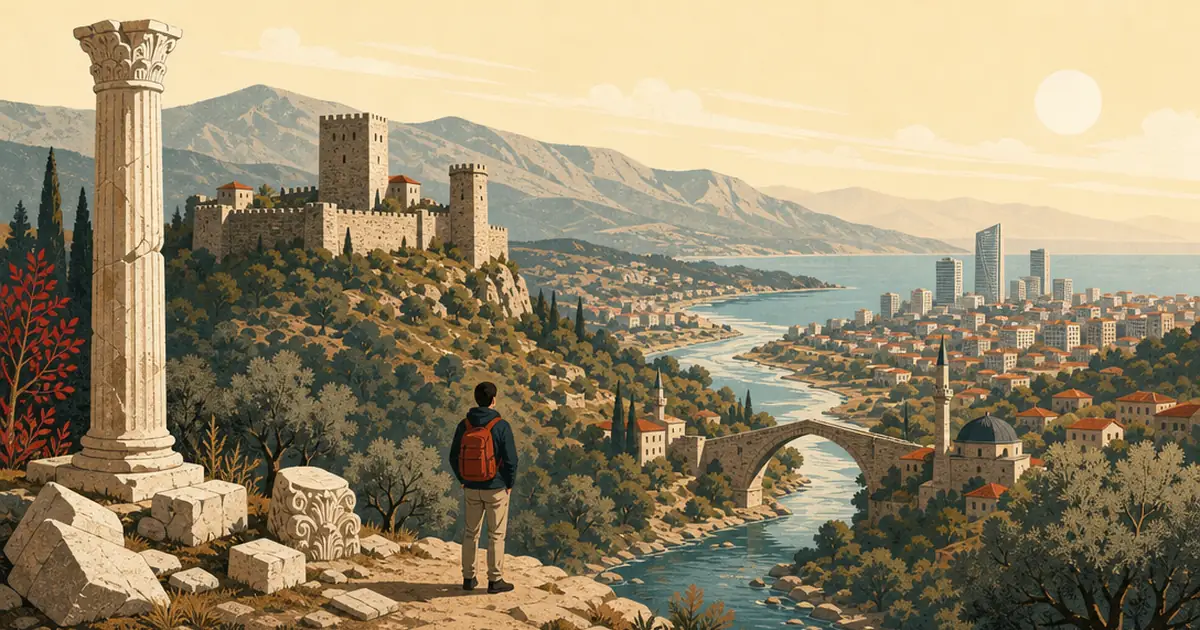
The history of Albania spans almost three thousand years. It begins with Illyrian tribes and ancient colonies on the Adriatic, then moves through medieval Arbëria, four and a half centuries of Ottoman rule and the national awakening. Independence in 1912 is followed by the monarchy, war and communism, and the story ends with a democratic state that belongs to NATO and is a candidate for membership of the European Union.
Below is a short guide to every period. Each one has its own detailed section, so you can read straight through or skip to whatever interests you.
Timeline: key dates in the history of Albania
The table below lists the milestones to know first, from the earliest Greek colonies to EU candidate status. Almost any topic in Albanian history connects to one of these dates, so together they work as a handy map of the whole story.
| When | What happened |
|---|---|
| 7th–6th centuries BC | Greek colonies of Epidamnos (Durrës) and Apollonia founded on the Illyrian coast |
| 168 BC | Rome defeats Gentius, the last Illyrian king |
| 395 | Division of the Roman Empire: the Albanian lands pass to Byzantium |
| 11th century | Byzantine authors first mention the Albanians (Arvanites) |
| c. 1190 | Principality of Arbër, centred on Krujë: the first Albanian state of the Middle Ages |
| 2 March 1444 | League of Lezhë, led by Skanderbeg |
| 17 January 1468 | Death of Skanderbeg |
| 1478–1479 | Fall of Krujë and Shkodër, beginning of Ottoman rule |
| 10 June 1878 | League of Prizren founded |
| November 1908 | Congress of Manastir: the basis of today's Latin alphabet |
| 28 November 1912 | Declaration of independence in Vlorë |
| January 1920 | Congress of Lushnjë; Tirana becomes the capital |
| 1 September 1928 | Albania proclaimed a kingdom, with Ahmet Zogu as king |
| 7 April 1939 | Invasion by Fascist Italy |
| November 1944 | Liberation of the country; the communists come to power |
| 11 January 1946 | People's Republic of Albania proclaimed |
| December 1990 | Student protests; political pluralism permitted |
| April 2009 | Albania joins NATO |
| June 2014 | Candidate status for EU membership |
The Illyrians and antiquity
In ancient times the Albanian lands were home to the Illyrians, Indo-European tribes of the western Balkans. Albanian historians regard them as the ancestors of the Albanians. The question is still debated, but the Illyrian era forms the foundation of the whole national story.
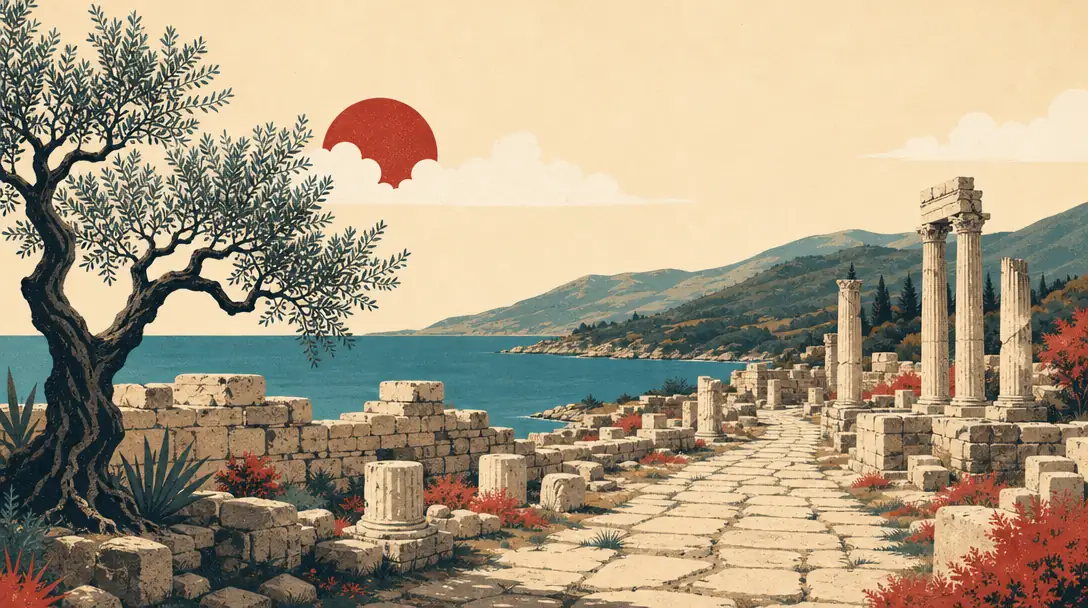
Several Illyrian tribes lived on the territory of present-day Albania. The Taulantii settled around Epidamnos, the Ardiaei near Shkodër and the Dardani in what is now Kosovo. In the 7th–6th centuries BC Greek colonies appeared on the coast. One was Epidamnos, later Dyrrhachium (today's Durrës); another was Apollonia, not far from Fier. Both traded with the Illyrians and became the region's gateway to the Mediterranean.
The first Illyrian kingdom took shape at the end of the 5th century BC. Its best-known king, Bardylis, was defeated by Philip II of Macedon in 358 BC. In the 3rd century the kingdom of the Ardiaei grew stronger. When King Agron died in 231 BC, his widow, Queen Teuta, took the reins of government, and her conflict with Rome led to the First Illyrian War of 229–228 BC. Further south, in Epirus, ruled Pyrrhus, whose costly victories over the Romans gave the world the phrase "Pyrrhic victory".
The last Illyrian king was Gentius, who ruled from Shkodër. The Romans defeated him in 168 BC, and the Illyrian lands became part of the Roman state. The Via Egnatia, the main Roman road in the Balkans, started from Dyrrhachium and linked the Adriatic with Macedonia and Thrace.
For more on the Illyrian tribes, their kings and the wars with Rome, see the section The Illyrians and ancient Albania.
Medieval Arbëria
When the Roman Empire was divided in 395, the Albanian lands went to its eastern half, Byzantium. In the Middle Ages the local people came to be called Arbër and their country Arbëria. The same root survives in the names of the Albanian communities in Italy and Greece, the Arbëreshë and the Arvanites.
The Slavs arrived in the Balkans in the 6th–7th centuries. For a long time afterwards the Albanian lands were a borderland contested by Byzantium, Bulgaria, Serbia and the Italian states. In the 11th century Byzantine authors mention the Albanians as a distinct people for the first time. The Great Schism of 1054 split these lands as well: the north leaned towards Catholic Rome, the south towards Orthodoxy.
Around 1190 the archon Progon founded the Principality of Arbër, centred on Krujë. It is considered the first Albanian state of the Middle Ages. In 1272 Charles I of Anjou proclaimed a "Kingdom of Albania" with Durrës as its capital. In the 14th century, after the Serbian conquests, power passed to local noble families: the Topia in Durrës, the Balsha in Shkodër, the Muzaka in Berat and the Kastrioti between Mat and Dibër.
The Ottomans first entered the region in force after the Battle of Savra in 1385, in which the ruler Balsha II was killed. The Middle Ages also left important cultural monuments. Among them are the Berat Codices, Gospels from the 6th and 9th centuries listed in UNESCO's Memory of the World register, and the "Baptismal Formula" of 1462, the oldest known text in Albanian.
On the principalities and culture of this period, see the section Medieval Albania.
Skanderbeg and the Ottoman era
The central figure of Albanian history is Gjergj Kastrioti, known as Skanderbeg (in Albanian Skënderbeu), who held back the Ottoman Empire for twenty-five years. For Albanians he is as much a symbol as the flag itself, and the double-headed eagle on a red field is associated with him.
Gjergj was the son of Gjon Kastrioti, a local lord. As a boy he was sent as a hostage to the sultan's court, where he converted to Islam and was given the name Iskander. In November 1443, during the battle near Niš, he deserted the Ottoman army and returned home, and on 28 November he took Krujë. On 2 March 1444, in the Cathedral of St Nicholas in Lezhë, the Albanian princes formed the League of Lezhë and chose Skanderbeg as its leader. He won his first major victory at Torvioll on 29 June 1444.
The Ottomans besieged Krujë three times: Sultan Murad II in 1450, and Mehmed II, the conqueror of Constantinople, in 1466 and 1467. The fortress never surrendered. Skanderbeg looked for allies in the West. In 1451 he signed the Treaty of Gaeta with Naples, and Pope Callixtus III gave him the title "Athlete of Christ".
Skanderbeg died in Lezhë on 17 January 1468. Without him the resistance soon crumbled: Krujë fell in 1478 and Shkodër in 1479. Ottoman rule began and would last more than four centuries. Some Albanians converted to Islam and made careers in the empire; others withdrew to the mountains or emigrated to Italy. By the 18th century powerful local dynasties governed almost independently of the sultan, among them the Bushati in Shkodër and Ali Pasha of Tepelena in Ioannina.
For more on Skanderbeg and the Ottoman period, see the section Skanderbeg and Ottoman Albania.
The National Awakening and the road to independence
In the 19th century the Albanians began their national awakening, the Rilindja Kombëtare ("National Renaissance"). Its aims were simple to state and hard to achieve: their own language in schools, a single alphabet, recognition as a distinct people and, in the end, a state of their own.
From 1839 the Ottoman Tanzimat reforms classified subjects by religion rather than nationality, so Albanians gained no right to schools in their mother tongue. Writers and teachers became the leading thinkers of the awakening, above all the Frashëri brothers, Abdyl, Naim and Sami. Naim Frashëri is regarded as Albania's national poet.
The year 1878 was a turning point. The Treaty of San Stefano handed lands with Albanian populations to Serbia, Montenegro and Bulgaria. In response, on 10 June 1878, the Albanian League, known as the League of Prizren, met in Prizren. It defended these territories by both arms and diplomacy until the Ottomans crushed it in 1881. On 7 March 1887 the first secular Albanian school, the Mësonjëtorja, opened in Korçë, and Albania still celebrates the date as Teachers' Day. In November 1908 the Congress of Manastir (Bitola) approved the "Bashkimi" Latin alphabet, the basis of the alphabet used today.
Between 1910 and 1912 a series of uprisings broke out against the Young Turk government. In October 1912 the First Balkan War began and neighbouring armies advanced into Albanian lands, so there was no time to lose. On 28 November 1912 an assembly in Vlorë led by Ismail Qemali declared Albania's independence. The date is the country's main national holiday.
On the League of Prizren, the alphabet and 1912, see the section The Albanian Renaissance and independence.
Independent Albania: 1912–1939
The first decades of independence were a fight for the state's very survival. The Great Powers decided the country's fate without consulting it, its neighbours laid claim to its lands, and at home rival factions fought for power.
In 1913 the Conference of Ambassadors in London recognised Albania as a sovereign principality, but most of the lands inhabited by Albanians, including Kosovo, were left outside its borders. A German prince, Wilhelm of Wied, was appointed ruler. He arrived in Durrës in March 1914 and was gone by September. During the First World War the armies of several states occupied the country.
In January 1920 the Congress of Lushnjë rejected plans to partition Albania, formed a government and made Tirana the capital. In December that year Albania was admitted to the League of Nations. Politics in the 1920s was turbulent. In June 1924 a government led by Fan Noli came to power, but by the end of December Ahmet Zogu was back in Tirana.
Albania became a republic in January 1925, with Zogu as president. On 1 September 1928 it was proclaimed a kingdom, and Zogu took the title "King of the Albanians". Royal Albania modernised its civil code, schools and army, yet it grew ever more dependent on Italian loans and influence.
Read more in the section Albania in 1912–1939.
The Second World War
Fascist Italy invaded Albania on 7 April 1939. King Zogu fled, and the country lost its independence for the rest of the war. After Italy capitulated in September 1943, Germany occupied Albania.
The resistance was split along political lines. In September 1942 the Peza conference set up the National Liberation Movement, which came increasingly under communist leadership. In the autumn of 1942 the nationalist Balli Kombëtar emerged. An attempt to unite the two at Mukje in August 1943 failed, and civil war broke out between them.
One of the finest chapters of the war is the rescue of Jews. Albanians refused to hand over lists of Jewish families to the Germans; instead they hid them and forged documents for them. By the end of the war there were more Jews in the country than before it began. This conduct is linked to besa ("pledge of honour"), the Albanian code that binds a person to keep their word.
In May 1944 the Congress of Përmet set up provisional governing bodies. Tirana was liberated on 17 November 1944 and the rest of the country by the end of that month. The communists, led by Enver Hoxha, took power.
On the war, the occupation and the rescue of Jews, see the section Albania in the Second World War.
Communist Albania
From 1944 to 1990 Albania was ruled by the Communist Party, and for almost all of that time by Enver Hoxha. The country went from an alliance with Yugoslavia to total isolation and became one of the most closed states in Europe.
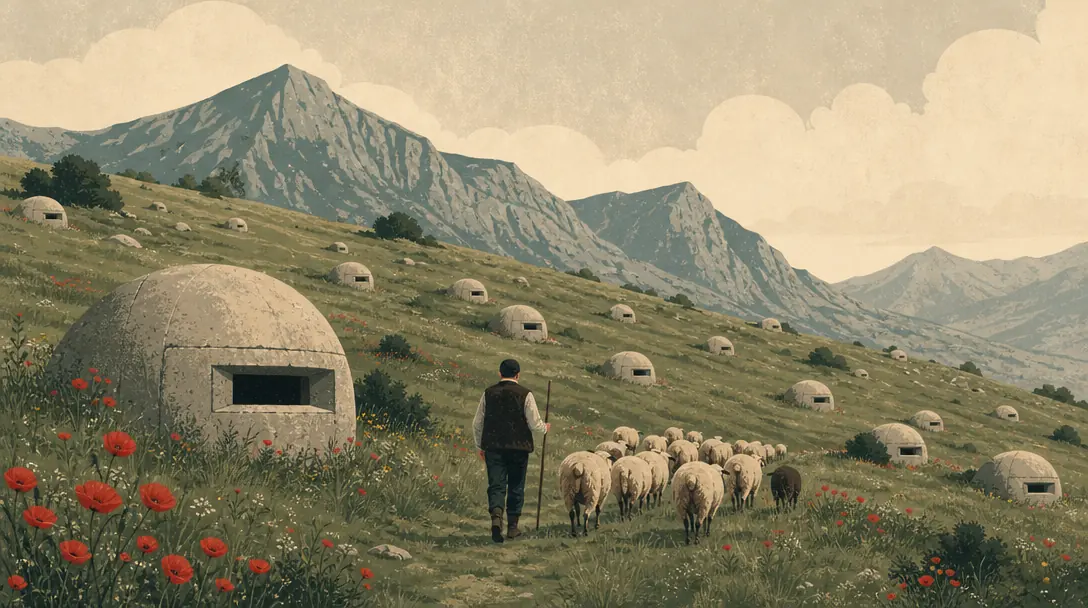
The People's Republic of Albania was proclaimed on 11 January 1946. Its foreign policy was a sequence of alliances and ruptures: with Yugoslavia until 1948, the USSR until 1961 and China until 1978. After that the country relied on itself alone. At home the regime nationalised industry, collectivised farming, wiped out illiteracy and built factories and power stations.
The price was high. Opponents of the regime were shot or sent to prisons and labour camps, and entire families were banished to internal exile. In 1967 Albania declared itself the world's first atheist state and closed every church and mosque. The era's best-known symbol is the roughly 173,000 concrete bunkers built against an invasion.
Enver Hoxha died on 11 April 1985 and was succeeded by Ramiz Alia. By the end of the 1980s the economy was in deep crisis. In July 1990 thousands of people poured into foreign embassies in Tirana in the hope of leaving the country.
Read more in the section Communist Albania.
Democracy, NATO and Europe
On 8 December 1990 students at the Student City in Tirana began a protest, and on 11 December the authorities allowed political pluralism. The first opposition party, the Democratic Party, was founded the following day. The country then began a long, difficult transition to democracy and a market economy.
The first multi-party elections took place in 1991. On 20 February that year protesters toppled the statue of Hoxha in Skanderbeg Square. The transition was painful, marked by mass emigration and the crisis of 1997, when the pyramid schemes collapsed and the country came close to civil war. "Alba", an Italian-led international mission, helped restore order.
Albania then turned firmly towards the West. It joined NATO in April 2009, applied for European Union membership the same year and was granted candidate status in June 2014. On 17 February 2008 Kosovo, where most of the population is Albanian, declared independence.
Read more in the section Democratic Albania and Kosovo.
Frequently asked questions
Who were the ancestors of the Albanians?
Albanian historians regard the Illyrians, Indo-European tribes who lived in the western Balkans in ancient times, as the ancestors of the Albanians. The question is not fully settled, and linguists and historians also discuss other theories. What is beyond dispute is that Albanians have lived in these lands since the early Middle Ages and appear in Byzantine sources from the 11th century.
Why is Skanderbeg considered a national hero?
Gjergj Kastrioti, known as Skanderbeg, led the resistance to the Ottoman Empire for 25 years. He united the Albanian princes in the League of Lezhë in 1444 and withstood three sieges of Krujë. His flag with the double-headed eagle became the basis of Albania's national flag.
When did Albania become independent?
Independence was declared in Vlorë on 28 November 1912 by an assembly led by Ismail Qemali. International recognition followed at the Conference of Ambassadors in London in 1913. Flag and Independence Day, 28 November, is Albania's main national holiday.
Why are there so many bunkers in Albania?
Enver Hoxha's communist regime built them in the 1970s and 1980s against a foreign invasion, because the isolated country expected an attack from any direction. About 173,000 concrete bunkers were built in total. Many are still standing, and some have been turned into museums and cafés.
When did Albania join NATO and the EU?
Albania joined NATO in April 2009. It is not yet a member of the European Union: it applied in 2009, received candidate status in June 2014 and is now negotiating accession.
In this section
Illyrians and Ancient Albania: Kingdoms, Rome and King Pyrrhus
The Illyrians built three kingdoms in what is now Albania before Rome conquered the region by 168 BC. Meet their tribes, Queen Teuta, King Pyrrhus and the Dardanians.
Medieval Albania: From Arbëria to the Principality of Arbanon
Medieval Albania spans a thousand years of Byzantine, Bulgarian, Norman, Angevin and Serbian rule. Out of it came Arbanon, the first Albanian state, and powerful 14th-century principalities.
Skanderbeg and Ottoman Albania: The League of Lezhë, Wars and Pashaliks
Ottoman forces reached Albania in the late 14th century and had conquered it by 1479. Between came 25 years of war under Skanderbeg, followed by centuries of Ottoman rule.
Albanian Independence: From the National Awakening to 1912
The Albanian National Awakening turned a cultural movement for language and schools into a state. Follow its path from the League of Prizren to independence in Vlorë in 1912.
Albania 1912–1939: From Independence to King Zog's Fall
Albania's first 27 years of independence were a fight for survival: Great Power rule, wartime occupation, the Congress of Lushnjë, the republic and King Zog's kingdom.
Albania in World War 2: Occupation, Resistance, Liberation
Italy seized Albania on 7 April 1939, and Germany took over in 1943. Resistance split into rival camps, and by November 1944 the country was liberated under communist rule.
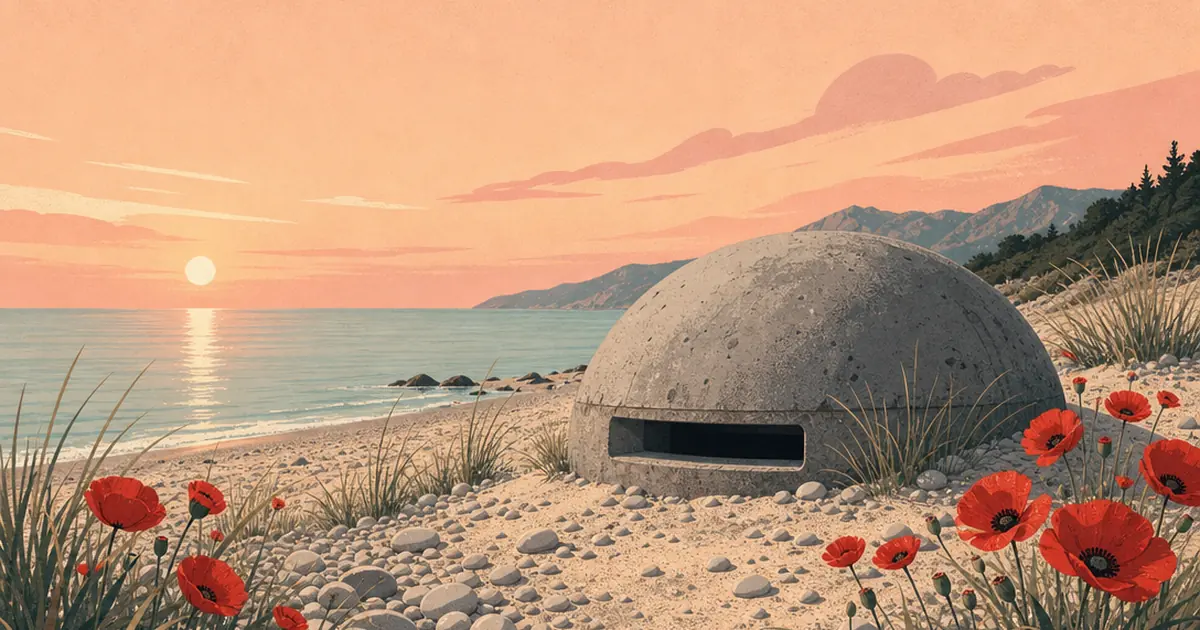
Communist Albania: Enver Hoxha, Isolation and the Bunker Legacy
From 1944 to 1990, the Communist Party ruled Albania under Enver Hoxha, abolishing private property and opposition while breaking with Yugoslavia, the USSR and China.
Albania After Communism: From 1990 Protests to NATO and Kosovo
Student protests in December 1990 ended one-party rule in Albania. Here is how the country survived the 1997 crisis, joined NATO and watched Kosovo become independent.