Illyrians and Ancient Albania: Kingdoms, Rome and King Pyrrhus
The Illyrians built three kingdoms in what is now Albania before Rome conquered the region by 168 BC. Meet their tribes, Queen Teuta, King Pyrrhus and the Dardanians.

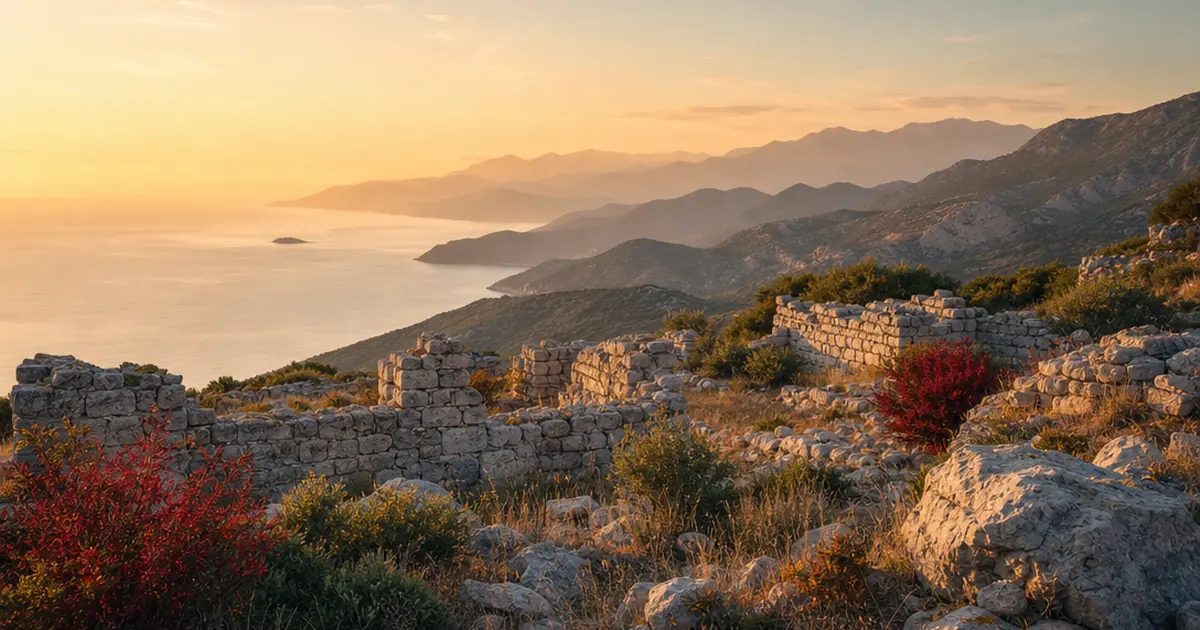
The ancient history of Albania is the story of the Illyrians, the Epirotes and the Greek colonies on the Adriatic. Three Illyrian kingdoms rose and fell here, and the Epirote state of Pyrrhus flourished in the south. The Dardanian kingdom grew up on the territory of today's Kosovo. Rome had subdued them all by 168 BC.
This is the first chapter of our guide to the history of Albania. It covers the period from the first human settlements to the Roman conquest, with the key names and dates.
Prehistory
People lived in what is now Albania long before the Illyrians. Neanderthals were here in the Middle Palaeolithic, and the Konispol cave in the south of the country holds traces of a settlement from around 24,700 BC. Prehistory ends with the appearance of writing, about 5,000 years ago.
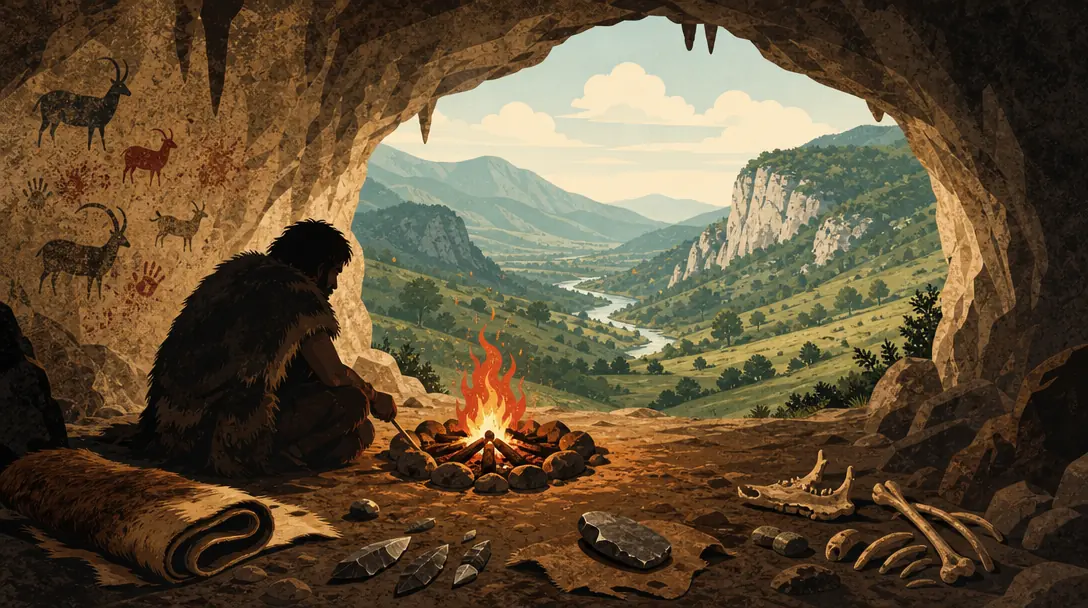
Historians divide this long stretch of time into the Stone Age and the Metal Ages. Each period left its own mark on the region.
| Period | Time | What appeared |
|---|---|---|
| Palaeolithic | until ~12,000 years ago | Neanderthals, later settlements, caves, the first art |
| Mesolithic | c. 10,000–6500 BC | New flint tools, the bow and arrow, the first attempts at farming and domesticating animals |
| Neolithic | 6500–4000 BC | Polished tools, permanent settlements, farming, herding, pottery |
| Copper Age (Eneolithic) | 4000–3000 BC | Copper, although stone remains the main material |
| Bronze Age | 3000–1100 BC | Walled settlements, burials under mounds (tuma, "burial mound") |
| Iron Age | 1100–500 BC | Hilltop settlements; the Illyrian tribes take shape |
The main Neolithic culture of south-eastern Albania is the Maliq culture, named after the settlement of Maliq near Korçë. The sites of Vashtëmi, Dunavec and Podgorie are also attributed to it. Neolithic settlements were built in the open, in caves or on stilts (pile dwellings).
In the south, in Epirus, lay Dodona, a sanctuary with an oracle of Zeus. Herodotus called it the oldest in the Hellenic world, and Strabo wrote that it was founded by the Pelasgians.
Who were the Illyrians?
The Illyrians were Indo-European tribes who held the western Balkans by the end of the Iron Age. The Albanian history textbook treats them as the region's native population. In its account, the Illyrians took shape here from the beginning of the 2nd millennium BC, in the Bronze Age.
There are two views on where the Illyrians came from. One sees them as newcomers to the western Balkans. The other sees them as a local population that formed over a long period, and this is the view taken by the Albanian school of history. The name "Illyrians" first appears in Herodotus, around the middle of the 5th century BC.
Illyrian lands stretched from the Sava and Drava valleys in the north to the Morava and Vardar in the east. To the west and south they extended from the Adriatic and Ionian coasts as far as the Acroceraunian Mountains. Further south, down to the Ambracian Gulf, lived the Epirotes.
The main tribes
There were many tribes, and different ones came to the fore in different centuries. These are the ones textbooks mention most often:
the Taulantii, around Epidamnus (Durrës), between the Mat and Shkumbin valleys;
the Ardiaei, around Lake Shkodër, with their centres at Rhizon and Scodra (Shkodër);
the Dardani, in and around the territory of modern Kosovo;
the Encheleae, by Lake Ohrid;
the Parthini in the Shkumbin valley, and the Dassaretae in south-eastern Albania;
the Amantes, in the hinterland of the Bay of Vlorë;
the Albani, in the area of Mat and Krujë.
The geographer Ptolemy was the first to mention the Albani, in the 2nd century AD. He also named their city, Albanopolis, which is identified with Zgërdhesh near Krujë. According to a widely held view, the name "Albanians" comes from this tribe.
The tribes shared a common culture. It shaped their way of life, their art, and their customs around birth, marriage and death, and the tribes traded actively with one another.
Cities, economy and language
The first Illyrian cities appeared at the end of the 5th century BC. They were built on hilltops and divided into zones: residential, public, religious, commercial and defensive. Their rise was preceded by advanced farming, herding and crafts, and by growing trade.
By then Greek colonies already stood on the coast. The Corinthians first founded Corcyra (Corfu). Around 627 BC, together with the Corcyraeans, they founded Epidamnus on Taulantian land; the city was later called Dyrrachium. Around 600 BC Corinthians led by Gylax founded Apollonia near Fier, originally called Gylakeia. Oricum had appeared by the middle of the 6th century BC. The colonies' population also included Illyrians, since the cities were founded on land the Illyrians already inhabited.
Language. Illyrian was an Indo-European language, and traces of it survive in modern Albanian. No Illyrian texts have come down to us, so the names of people and places are known only as Greek or Latin authors recorded them.
Religion. The Illyrians worshipped the great gods of the ancient world but gave them local features. The snake and the sun held a special place, and there were also myths about animals and natural phenomena.
The three Illyrian kingdoms
Illyrian statehood went through three stages. The first kingdom formed at the end of the 5th century BC and the second at the end of the 4th. The third, with its capital at Shkodër, lasted until 168 BC, when Rome destroyed it.
Other ancient states also existed in and around these lands: the Epirote state, the Dardanian kingdom and the city-states of Dyrrachium and Apollonia.
The first kingdom. The first kingdom was centred on the lands of the Encheleae and ruled by the dynasty of Bardylis until about 350 BC. Bardylis himself is considered the first Illyrian king whose existence is beyond doubt. In 358 BC he was defeated by Philip II of Macedon, the father of Alexander the Great, and the kingdom went into decline.
The second kingdom. In the last quarter of the 4th century BC the kingdom revived under the dynasty of Glaukias, and its centre moved to the land of the Taulantii. Glaukias's power extended over Dyrrachium and Apollonia. He sheltered and raised the young Pyrrhus, the future king of Epirus, and put him on the Epirote throne while Pyrrhus was still a child. The dynasty fell in the middle of the 3rd century BC.
The third kingdom. The centre shifted north, to the Ardiaei and the Labeates, and Scodra (Shkodër) became the capital. The best-known rulers were Pleuratus, Agron, Teuta and Gentius. In 231 BC Agron won a famous victory over the Aetolians at the city of Medion, but he died the same year. Power passed to his widow Teuta, who ruled as regent for Agron's young son Pinnes.
The Illyrian–Roman wars
Rome fought the Illyrians for more than 60 years, from 229 to 168 BC, driven by its ambitions in the Balkans. There were three wars. They ended with the fall of the last Illyrian kingdom and its absorption into Roman territory.
The First War (229–228 BC) broke out after one of the Roman envoys sent to Teuta was killed. Under the peace of 228 BC the kingdom had to pay tribute to Rome and give up most of its lands. It also agreed not to sail south of Lissus (Lezhë) with more than two ships, and those unarmed. Teuta lost power, and Demetrius of Pharos, an ally of Rome, became the kingdom's leading figure.
The Second War (219 BC) was fought against Demetrius himself, who had begun to pursue a policy independent of Rome. His main strongholds, Dimale and Pharos, fell. The Romans were led by Lucius Aemilius Paullus, and Demetrius fled to Philip V of Macedon.
The Third War was decisive. Gentius, who ruled from 181 BC, allied himself with the Macedonian king Perseus against Rome. In 168 BC the Roman commander Lucius Anicius Gallus defeated him at Scodra. The following year Gentius was taken to Rome as a prisoner.
Why did the Illyrians lose? The textbook gives three reasons: the pro-Roman stance of Dyrrachium and Apollonia, the betrayal by Demetrius of Pharos, and a Roman army almost twice the size of theirs.
After 168 BC Rome reorganised the administration of the region and carried out a land reform that settled colonists. Some Illyrian cities were destroyed, others were made Roman colonies, and new ones were founded. Work began on the Via Egnatia, starting from Dyrrachium. It became the main Roman highway in the Balkans, linking Illyria with Macedonia and Thrace.
Epirus and King Pyrrhus
Epirus is a historical region covering the south of present-day Albania and north-western Greece. Three main tribes lived here: the Chaonians in the north-west, the Molossians in the centre and the Thesprotians in the south. The Epirote state reached its peak under King Pyrrhus in 297–272 BC.
Epirus stretched from the Ambracian Gulf in the south to the Llogara Pass and the Vjosa valley in the north, and from the Pindus Mountains in the east to the Ionian Sea in the west. In the second half of the 4th century BC its main cities were Gitana and Phoenice (Finiq).
How the state changed. First came the Molossian kingdom, under King Tharyps and his son Alcetas, and then the Molossian League led by Alexander of Molossia. This Alexander was the uncle of Alexander the Great; he died around 331 BC in southern Italy, at the battle of Pandosia. Later the Epirote League emerged as a federal state. In the 230s BC the monarchy in Epirus fell, and the league became a republic.
Pyrrhus and the "Pyrrhic victory"
Epirus grew stronger under Pyrrhus. The king consolidated his power, pursued an independent foreign policy, and brought the state military and economic success. In 295 BC he founded Antigonea near Gjirokastër, naming it after his first wife, Antigone.
His enemies included Rome, Carthage, Macedonia, Sparta and Argos, and he fought the Carthaginians in Sicily. In 280 BC Pyrrhus defeated the Romans at Heraclea, and then again at Asculum. His losses were so heavy that they gave us the expression "Pyrrhic victory": a win that costs more than a defeat would. While Pyrrhus was fighting in Italy, the Romans came to an agreement with the Carthaginians. In 275 BC he lost to the Romans at Beneventum, and in 272 he died in Argos.
Epirus met a brutal end. In 167 BC Lucius Aemilius Paullus plundered 70 Epirote cities and enslaved about 150,000 people, and Epirus came under Roman rule.
The Dardanian kingdom
The Dardanian kingdom formed in the 4th century BC, centred on the territory of modern Kosovo. It was rich in metal ores and occupied an advantageous position between the Balkan powers. At its height its lands reached Naissus (Niš) in the north and the Vardar in the south.
The main cities of Dardania were Damastion, Scupi (Skopje), Naissus and Ulpiana, and the state was ruled by a king. The ancient author Agatharchides, as quoted by Athenaeus, wrote that the Dardanians kept many slaves, some owning a thousand or more. In peacetime these slaves worked the land.
Around 280 BC a large Celtic invasion threatened Dardania. Its known kings include Longarus, Bato and Monunius. In 201 BC Bato sided with Rome against Philip V of Macedon.
The alliance with Rome did not last. After the Roman conquest of Macedonia, relations turned to war, which the textbook dates from 76 BC. In 28 BC Marcus Licinius Crassus annexed Dardania, and it became part of the Roman province of Moesia. At the end of the 3rd century AD it became a province in its own right. The Byzantine emperor Justinian I came from Dardania: he was born around 482 in Tauresium, not far from Skopje.
What ancient authors wrote about the Illyrians
The Illyrians left no writings of their own, so their history has to be pieced together from Greek and Roman authors and from archaeology. One of the oldest references to these lands is in Homer's Odyssey, which mentions the Thesprotians of Epirus.
The main sources on the Illyrian tribes are Strabo's Geography (1st century BC – 1st century AD) and the work of Ptolemy (2nd century AD). The name "Albani" first appears in Ptolemy. Herodotus, as mentioned above, was the first to name the Illyrians, and he also left an account of the Pelasgians and Dodona.
Next: Medieval Albania, covering Byzantium, Arbër and the first Albanian principalities.
Frequently asked questions
Are the Illyrians the ancestors of the Albanians?
Albanian historical scholarship holds that they are, and the school textbook is built on this view. It sees traces of the Illyrian language in modern Albanian, and the name "Albani" first appears in Ptolemy as the name of one of the Illyrian tribes. In international scholarship the question is still debated.
Who was the last Illyrian king?
The last king was Gentius, who ruled from his capital at Shkodër from 181 BC. He allied himself with Macedonia against Rome. In 168 BC he was defeated by Lucius Anicius Gallus and later taken to Rome as a prisoner.
Who was Queen Teuta?
Teuta was the widow of Agron, king of the Ardiaei. After his death in 231 BC she ruled as regent for his young son. The First Illyrian–Roman War broke out during her rule, and she lost power after it.
Was Pyrrhus an Illyrian?
No, Pyrrhus was a king of Epirus from the Molossian line. His link to the Illyrians goes back to his childhood. Glaukias, king of the Taulantii, sheltered and raised him and put the boy on the Epirote throne.
What was the Via Egnatia?
The Via Egnatia was a Roman road that started at Dyrrachium (today's Durrës) and ran across the Balkans to Macedonia and Thrace. Work on it began after the Roman conquest. It became the region's main overland highway.