Medieval Albania: From Arbëria to the Principality of Arbanon
Medieval Albania spans a thousand years of Byzantine, Bulgarian, Norman, Angevin and Serbian rule. Out of it came Arbanon, the first Albanian state, and powerful 14th-century principalities.

Contents8 sections
- Early medieval Albania: from Illyria to Arbëria
- The Koman culture and continuity
- Between East and West: the 11th–12th centuries
- The Principality of Arbanon, the first Albanian state
- The medieval Kingdom of Albania and the Serbian conquest
- The Albanian principalities of the 14th century
- Towns and countryside in medieval Albania
- Faith, art and the first books in Albanian
- The key monuments
- FAQ
Medieval Albania covers the thousand years between the end of the ancient world and the arrival of the Ottomans. The Albanian lands belonged to Byzantium and were conquered in turn by the Bulgarians, Normans, Angevins and Serbs. The Albanians themselves, known then as Arbërs, founded their first principality around 1190 and several strong principalities in the 14th century.
This is the second chapter of our guide to the history of Albania. It runs from the division of the Roman Empire to the Battle of Savra and the first books in Albanian.
Early medieval Albania: from Illyria to Arbëria
After the Roman Empire was divided in 395, the Albanian lands passed to its eastern half, Byzantium. Sources go on calling the people Illyrians until the 6th century. From the 11th century, the inhabitants of southern Illyria appear as Arbërs and their country as Arbëria.
In the late Roman Empire these lands belonged to the Prefecture of Illyricum, which had four provinces here:
| Province | Location |
|---|---|
| Praevalitana | The north, down to the Shkumbin river |
| Dardania | Present-day Kosovo and neighbouring lands |
| Epirus Nova | Between the Shkumbin and the Vjosa |
| Epirus Vetus | From the Vjosa to the Ambracian Gulf |
These were turbulent centuries. Goths and Huns plundered the country, burning villages and destroying towns. In the 6th–7th centuries Slavs settled in the Balkans with the permission of the Byzantine emperors. Southern Illyria resisted assimilation for several reasons: its economy was more developed, its population more cohesive, its terrain mountainous and its coast well fortified. The Slavs who did reach the area were gradually absorbed into the local population.
In the 8th–10th centuries Byzantium reorganised its territory into themes. Each theme was run by a strategos (military governor), who held both military and civil power. One of these themes was Dyrrhachium, today's Durrës.
The Koman culture and continuity
The most important archaeological evidence from this period is the Koman-Krujë culture, dating mostly from the 7th–9th centuries. Finds come from Koman (Dalmaca hill), Krujë and Lezhë. Albanian historians see it as proof that the Arbërs descend directly from the Illyrians.
The school textbook groups the arguments for this continuity into three kinds:
archaeological, such as medieval fortress walls built on ancient foundations;
linguistic, such as personal names and the names of towns, mountains and rivers;
ethnographic, such as elements of Illyrian dress.
The first mention of the Albanians. The Byzantine historian Michael Attaleiates writes about the Arvanites when describing the uprising of 1078–1079 in the theme of Dyrrhachium. This is the first time Byzantine history records the Albanians as a distinct people.
Between East and West: the 11th–12th centuries
In the 11th–12th centuries the Albanian lands lay at a crossroads, fought over by Byzantium, Bulgaria, the Normans of southern Italy and Venice. The Great Schism of 1054 also split Arbëria itself: the north became Catholic, while the south stayed Orthodox.
Bulgarian rule over part of the Arbër lands began in the mid-9th century and ended in 1018, when the Byzantine emperor Basil II conquered Bulgaria. That same year Berat surrendered to Byzantium without a fight.
Then came the Normans. In 1081 the forces of Robert Guiscard and his son Bohemond took Vlorë, Kaninë, Orikum, Bylis, Butrint and Corfu and besieged Durrës. Guiscard left a few years later, but the Normans kept coming back. Bohemond invaded again in 1107, and in 1185 a Norman king landed on the coast once more, only to retreat to Italy within the year. Anna Komnene also describes the Norman invasion of 1081 in the Alexiad, where she mentions Arbanon.
The Principality of Arbanon, the first Albanian state
Around 1190 the archon Progon founded the Principality of Arbër (Arbanon), centred on Krujë. It is regarded as the first Albanian state of the Middle Ages. The ground had been prepared earlier: in 1166 the sources first mention a high-ranking local ruler in Arbër.
Progon was succeeded by his sons Gjin (1198–1208) and Dhimitër (1208–1216). Under Dhimitër the principality was at the height of its power. In 1209 he signed a treaty with the Republic of Ragusa (Dubrovnik), and around the same time he forged closer ties with Pope Innocent III.
Threats came from three directions: the Serbian kingdom of Raška, the Venetians in Durrës and the Despotate of Epirus. After Dhimitër, power passed to Grigor Kamona and then to Golem. In 1256–1257 the Empire of Nicaea annexed Arbër.
The Despotate of Epirus. After the Fourth Crusade of 1204, Byzantium temporarily collapsed and Venice seized Durrës. In 1205 Michael I Komnenos Doukas founded the Despotate of Epirus in the south, with Arta as its main capital. It became one of Arbëria's most powerful neighbours. In 1230, however, the Bulgarians defeated its ruler Theodore Komnenos Doukas at Klokotnitsa, and the despotate went into decline.
The medieval Kingdom of Albania and the Serbian conquest
On 21 February 1272 Charles I of Anjou was proclaimed King of Albania (Regnum Albaniae) under an agreement with the Albanian nobility and the townspeople of Durrës. Durrës became the capital, and the Angevins held on to the coast for almost a hundred years.
Meanwhile Serbia was growing stronger in the north. King Stefan Dušan exploited a Byzantine civil war to capture most of the Arbër lands in 1343–1345, and by 1348 he had reached Thessaly.
Serbian rule weighed heavily on the Arbërs. Their leaders were arrested and stripped of their land, and estates were handed over to Serbian feudal lords. People were forcibly converted to Serbian Orthodoxy, and Slavic names spread. When Dušan died in 1355, his realm quickly broke up, and local noble families rose to power in the Albanian lands.
The Albanian principalities of the 14th century
By the second half of the 14th century almost all the Albanian lands were shared among a handful of princely families. The strongest were the Thopia in Durrës, the Balsha in Shkodër and the Muzaka in Berat. Each principality had its own institutions, symbols, seals and coins.
Thopia. Tanush Thopia founded the Principality of Durrës. It reached its peak under Karl Thopia, who took Durrës from the Angevins in 1368.
Balsha. The Balsha ruled Zeta and the coast from their administrative centre in Shkodër (roughly 1362–1421). The principality was governed by Balsha I and his three sons, Stracimir, Gjergj I and Balsha II. Each held his own region, but they presented a united front to the outside world. Through marriage the family acquired Berat and Vlorë. Their income came from tithes, customs duties, the salt trade and land.
Muzaka. The Muzaka ruled Berat and Myzeqe. Andrea II Muzaka founded the principality, which reached its greatest extent under Teodor II. In 1335 the domain became a despotate, and it lasted until the Ottoman conquest in 1417.
So why did none of them last? The textbook gives three reasons: powerful neighbours, internal feuds and the splitting of lands among heirs.
The Battle of Savra. On 18 September 1385, near Lushnjë, the Ottomans defeated Balsha II, who died in the battle. Karl Thopia had called them in to help him. Afterwards most local lords became vassals of the sultan. The Balsha dynasty died out in 1421, when Balsha III died childless.
Towns and countryside in medieval Albania
Medieval Arbër towns and the land around them were self-governing communes, each with its own statutes, seal and coinage. A council of nobles ran the town and elected its head, the kont (count). Society was divided into the nobility and the ordinary townspeople, the popolani (commoners). Craftsmen were organised into guilds.
Medieval Shkodra was known far beyond Arbëria for its swords, its bell-founding and its gold and silver work. In the countryside, land was divided into the bashtinë (family holding), common land and church land. Military service was rewarded with grants called stratiotika and pronoia. Dependent peasants were known as paroikoi.
Faith, art and the first books in Albanian
According to the textbook, the Illyrians adopted Christianity in the 4th century, and Shkodra, Durrës and Nicopolis became centres of the faith. Medieval Arbëria left behind Byzantine, Romanesque and Gothic churches, mosaics, icons painted on wood, masterpieces of embroidery and the oldest surviving examples of Albanian writing.
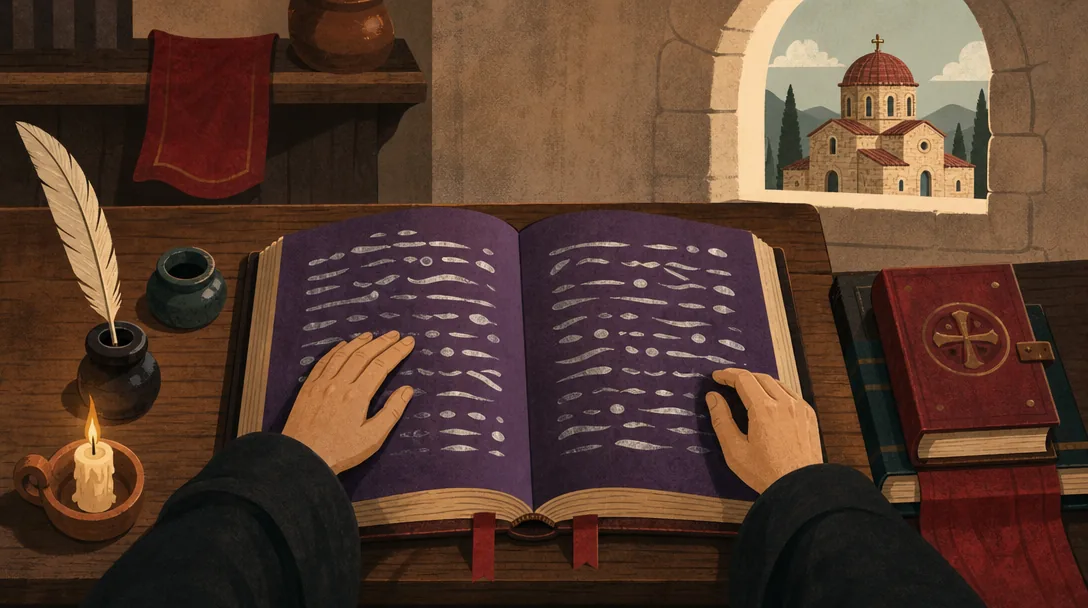
Church art drew heavily on Constantinople and Rome. Wall and floor mosaics carried on the ancient tradition. Fortresses from the period come in both round and rectangular forms. Schools were attached to churches, and literature was mostly religious: codices and lives of saints.
The key monuments
The Berat Codices. The first (Beratinus 1) is a 6th-century Greek Gospel written in silver ink on purple parchment. The second (Beratinus 2) dates from the 9th century and is written in gold ink on purple parchment. In 2005 both were added to UNESCO's Memory of the World Register.
The Epitaph of Glavenica is a masterpiece of medieval embroidery, made in 1373 for Gjergj Arianiti, who commissioned it.
The baptismal formula of 8 November 1462 is the oldest known written document in Albanian. It was composed by Pal Engjëlli, Archbishop of Durrës.
Gjon Buzuku's Meshari (The Missal, 1555) is the first printed book in Albanian, written in the Gheg dialect. It uses the Latin alphabet with a few characters borrowed from Cyrillic and Greek.
A note from 1332 shows that Albanians were writing in the Latin script long before these texts. In it the Dominican friar Guillaume Adam (Brocardus) remarked that they used Latin letters in their books. To find out how these different scripts gave way to today's alphabet in 1908, see our page on the Albanian alphabet.
Next: Skanderbeg and Ottoman Albania. Back: The Illyrians and ancient Albania.
Frequently asked questions
Which state is considered the first Albanian state?
The first Albanian state is the Principality of Arbër (Arbanon), centred on Krujë. The archon Progon founded it around 1190, and it was at its most powerful under his son Dhimitër in 1208–1216. In 1256–1257 the Empire of Nicaea annexed it.
Where does the word "Arbëria" come from?
In the Middle Ages this was the name of the country, and its people were called Arbërs; the sources use these names from the 11th century. The names of the Albanian communities in Italy and Greece, the Arbëreshë and the Arvanites, share the same root. The name Albanians use for themselves today, shqiptarë (Albanians), spread later.
What was the Kingdom of Albania of 1272?
It was a kingdom ruled by Charles I of Anjou from 21 February 1272, under an agreement with the Albanian nobility and the townspeople of Durrës. Its capital was Durrës. The kingdom's power was mostly confined to the coast.
What happened at the Battle of Savra?
On 18 September 1385, near Lushnjë, the Ottomans defeated Prince Balsha II, who died in the battle. They had been invited in by Karl Thopia, Balsha's rival. After the battle, most Albanian lords became vassals of the sultan.
What is the oldest text in Albanian?
The oldest is the baptismal formula of 1462, composed by Pal Engjëlli, Archbishop of Durrës. The first printed book is Gjon Buzuku's Meshari of 1555.